

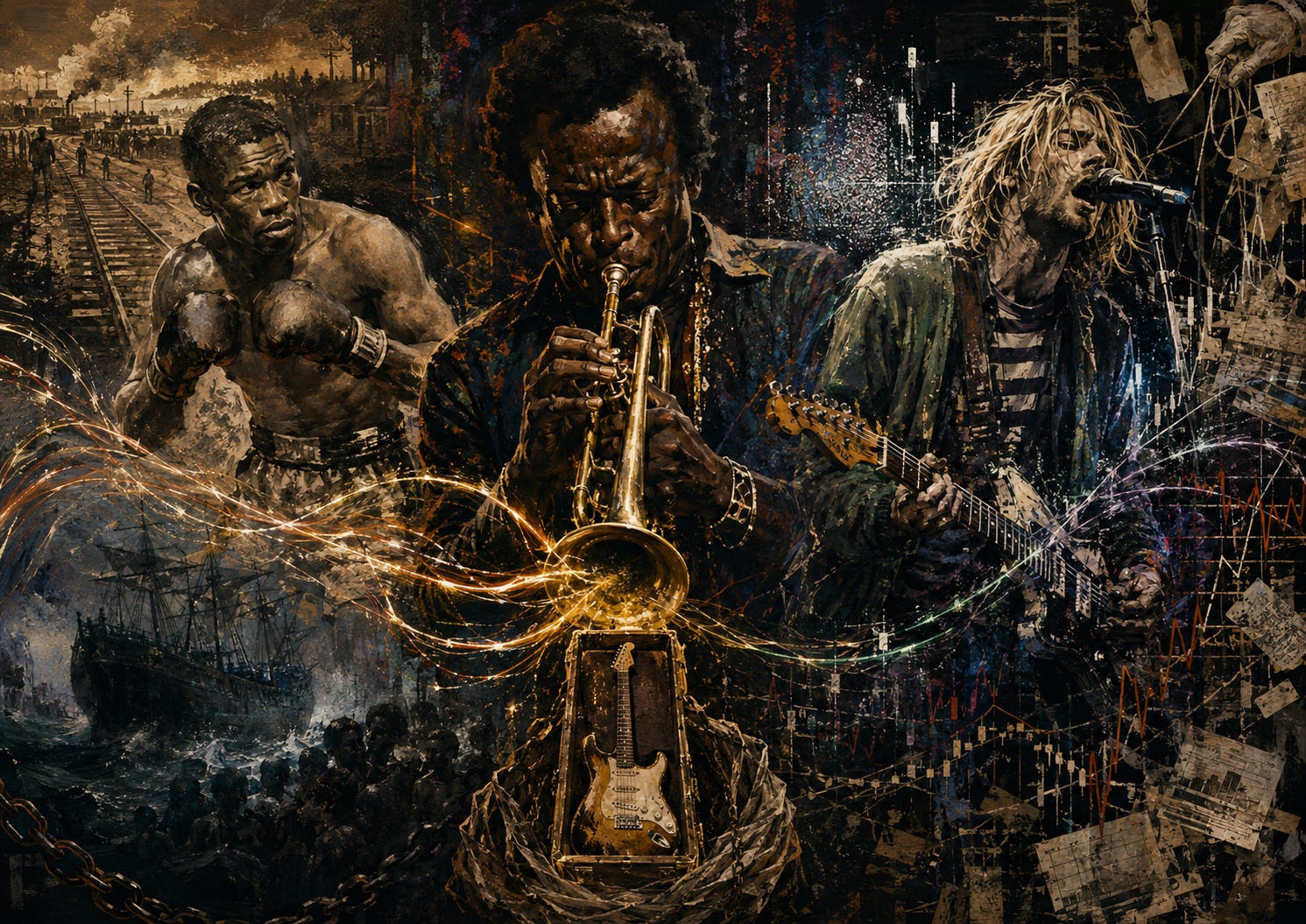
Put on A Tribute to Jack Johnson. The first track, “Right Off,” opens with an immediate driving figure: Michael Henderson’s electric bass laying down a hard funk groove in E, Billy Cobham’s drums entering with the precision of someone who has decided the track will not slow down, John McLaughlin’s guitar threading between the rhythm with the kind of fragmented, slashing line that would soon become the signature of Mahavishnu Orchestra. The figure is aggressive from the first second. There is no introduction. The body is already inside the music before the body has decided to listen.
The autobiography Miles Davis wrote with Quincy Troupe opens with the command the Soundchaser method requires.
Listen.
What follows is not a memory of musical preference. It is a record of bodily rearrangement. Davis says the greatest feeling he ever had in his life, with his clothes on, was when he first heard Dizzy Gillespie and Charlie Parker together in St. Louis in 1944. Davis was eighteen. He had just graduated from Lincoln High School in East St. Louis. Billy Eckstine’s band had come into St. Louis to play the Plantation Club, owned by white gangsters. The gangsters told Eckstine he had to come in through the back door. Eckstine ignored them, brought the whole band through the front, and the gangsters fired him on the spot.
Jordan Chambers, the most powerful Black politician in St. Louis at the time, told Eckstine to bring the band over to the Riviera Club, the all-Black club at Delmar and Taylor. The band moved across town. Davis picked up his trumpet and went over to see if he could catch the rehearsal.
The Soundchaser recognition Davis had that night is inseparable from that infrastructure. The transcendent musical event happened at the Riviera because Black St. Louis had built the conditions under which a band including Dizzy Gillespie, Charlie Parker, Gene Ammons, Lucky Thompson, Art Blakey, Buddy Anderson, Sarah Vaughan, and Eckstine himself could play together inside an apparatus that did not want the band coming through the front door.
The institutional refusal at the Plantation Club and the Black political and social infrastructure that made the Riviera available were the conditions of possibility for what Davis heard. The night was not a transcendent musical event delivered to a passive listener. The night was what survived after Eckstine had refused the back door and Chambers had offered the alternative venue.
Inside the Riviera, a man Miles did not recognise ran up to him asking if he was a trumpet player and had a union card. The man took him up on the bandstand and put music in front of him. He could read music, but he had trouble reading what had been placed before him because he was so in awe listening to what everyone else was playing. The man who had run up to him was Dizzy Gillespe. Davis had not recognised him until Dizzy started playing, and then he could not play because he was listening.
The music was ‘all up in his body’. This is what he says his career keeps returning to. Not influences or admiration. Not the genealogy of jazz history, with proper nouns placed in chronological order and left to behave themselves. But he heard something and could not keep functioning as who he had been before hearing it. The sound entered before the explanation. A young player stood on the bandstand and failed to play at first because listening to the other players had become more urgent than performance.
Sarah Vaughan was in the band that night, Miles registered, at eighteen, what Vaughan’s musical authority was. He said she could not be treated as decoration, she was another horn. She was inside the same musical intelligence as Bird and Diz, they heard it and Miles heard that too. He saw the men look at her as another horn, as another force inside the music’s architecture, not as a singer placed on top of the band for sweetening. That recognition ran underneath his work afterward, even where the visible surface of the work was almost entirely male. Authority had entered through voice. Voice had entered as horn. The body registered the fact before the culture could be trusted to name it.
The mentorship that began that week is what made the rest possible. Miles would later write that as much as he loved Bird, without Dizzy he would not have become what he became. When he moved to New York later that year to study at Juilliard, Dizzy took him everywhere: to the booking office, to his house, into rooms, into jokes, into danger, into the social and musical atmospheres where the music lived before it became repertoire. Dizzy’s wife Lorraine put up signs telling people not to sit in certain places and let nobody stay too long, except Miles. Dizzy took him into his first elevator, somewhere on Broadway in midtown Manhattan, and liked to make faces at white people and scare them. Dizzy took him to the Today show studio at Rockefeller Plaza and stood outside the plate glass window sticking his tongue out at J. Fred Muggs, the chimpanzee Dave Garroway kept on the set, until the chimpanzee was screaming and jumping and showing his teeth while the show went out live.
Miles stood beside him watching.
That is the lineage “Right Off” sits inside. Not jazz history as an abstraction. Not the museum corridor of innovations, period styles, and canonical names. The lineage of a specific older musician taking a specific younger musician everywhere, including the elevators and his lived experience meeting the chimpanzee, because that was what taking-into-things meant in 1944. Miles closes the prologue to his autobiography by saying he had come close to matching the feeling of that night in music, but never all the way. He was always looking for it, listening and feeling for it, trying to feel it in and through the music he played every day.
The lifelong reaching is what his body did with what it had been given access to at eighteen.
Between 1944 and 1971 a great deal happened to that body. The years in Bird’s quintet from 1947. The Birth of the Cool sessions in 1949 and 1950. The descent into heroin addiction across the early 1950s: borrowed money, failed gigs, impaired playing, pawned trumpets, the period Davis later named as the time he lost control of his life. Then, in early 1954, the cold turkey kick.
The kick is documented in detail because Davis described it directly. In the Troupe autobiography and in the 1985 SPIN interview that became part of the source material for the book, Davis attributed his ability to break the habit to the example of his hereos Sugar Ray Robinson, and Jack Johnson the boxing champions, that inspired him. If Robinson could win all those fights, if Johnson could become champion against the opposition of a whole nation Miles told himself , he could break the habit. He went home to his father’s farm outside East St. Louis and sweated it out.
His body paid for the decision. He lay staring at the ceiling for days. Cold sweat. Running nose. Running eyes. Vomiting. Pores opening. Cursing everyone he disliked. No romance. No spiritual montage. No soft-focus redemption with trumpet obligato. The body had to carry what that decision required.
The discipline was extracted from other black men’s bodies example of what could be sustained under sustained pressure. Robinson was middleweight champion of the world five times across the 1950s. The discipline of his career, the body absorbing what other men could not absorb, continuing to win when his apparatus told him he was finished, was what Miles identified with at the worst point of his own decline.
Robinson was the contemporary example. Jack Johnson occupied a different position in Miles’ imagination. Johnson was the historical figure, the original of a pattern Davis recognised in his own situation. The first Black heavyweight champion of the world, who had taken the title from Tommy Burns in Sydney in 1908, outside the United States because no American venue would host the fight. Who had married three white women across a period when interracial marriage was illegal across most of the American South. Who had been prosecuted under the Mann Act in 1913 in a case that was transparently racial. Who had fled the country, fought championship bouts in exile across Europe and Latin America, returned in 1920 to serve a year at Leavenworth, and died in 1946 in a car crash in North Carolina after being refused service at a segregated diner.
Johnson published his own account of his life in 1927, at forty-nine. In the Ring and Out. The voice in it is unsentimental and unafraid. He says he is astounded to realise that few men in any period of history have lived a more varied or intense existence. Tragedy and romance. Failure and success. Poverty and wealth. Misery and happiness. That is Johnson on the record about himself: the body that lived inside the configuration the country had built to destroy him, reporting from inside it in his own diction.
Behind that body, another body.
Henry Johnson, Jack’s father, formerly enslaved, disabled after wartime service, his own life shaped by the war that ended slavery without ending the machinery that had made slavery profitable. The son grows into a man whose movement will be watched, challenged, priced, celebrated, punished. The body that was supposed to remain in the assigned place becomes motion itself: footwork, punch, automobile, exile, return.
And before that, the cargo hold. Tom Feelings’s The Middle Passage: White Ships / Black Cargo does not explain the forced crossing. It does not protect the viewer with narration. The images carry what prose cannot safely soften. White ships. Black cargo. Bodies compressed into transport before road or rail or ring or studio can make their later claims on motion. The sea is not background. The ship is not only vehicle. The first machinery is the hold: breath rationed by timber, limbs folded into inventory, personhood forced into cargo shape.
That image sits beneath the later routes without needing to announce itself. The plantation road. The rail line. The touring circuit. The back door. The club across town. The boxing ring in Sydney. The prison route to Leavenworth. The studio in New York. The tape spool. The record shipment. The streaming file. Each later movement carries the dark memory of bodies first made transportable as property.
Johnson’s body enters Miles imagination from inside that long transport history. Not as victim. Not as emblem. As force. As defiance made physical. As motion that refused the posture assigned to it.
In 1970 the documentary filmmaker William Cayton released Jack Johnson, narrated by Brock Peters, drawing on archival footage of Johnson’s fights and life. The film treated Johnson as a figure of sustained dignity rather than as a tragic exemplum or racial cautionary tale. Cayton needed a score and commissioned Miles.
Miles was forty-four. Bitches Brew had been released earlier that year and had sold half a million copies, an unprecedented commercial return for what was nominally a jazz record. Clive Davis had taken over Columbia Records as president in 1967 and had been pushing Miles toward larger audiences, rock crossover, and the production schedule that would deliver commercial returns commensurate with what Columbia was investing in him.
The body Miles brought to the Jack Johnson sessions in late 1970 and early 1971 was a body under institutional pressure, contractual obligation, beginning physical decline, and his cocaine habit and drinking that would, by his own account, structure much of the next decade. The earlier heroin kick was sixteen years behind him. The discipline Robinson’s example had supplied was still operative.
Whether the recording industry consciously used artists’ addictions as leverage against them is a question the literature treats with care. What is documented is that Columbia was extracting an enormous commercial return from Davis’s work, that the contracts assumed continuous production whatever his physical condition, and that the institutional apparatus that depended on his continued output was aware of his state. The broader literature on the music industry of the period substantially supports the pattern as operative across many Black artists. The specific application to Davis is more contested.
The reading here is not biographical proof. The reading is that Miles was working inside an extraction configuration, that the configuration was real, and his body knew. Whether his body consciously knew the dynamic is unknowable from outside. Whether the body knew somatically is a different question.
The answer is of course in the music.
What the body did with what it was carrying is most precisely visible in how “Right Off” came to be recorded.
Ian Carr’s biography reports the session from inside. The band had set up in Columbia’s Studio B in New York. Steve Grossman on soprano sax. Herbie Hancock on a Farfisa organ that was reportedly broken. John McLaughlin on guitar, just before he would form Mahavishnu Orchestra. Michael Henderson on electric bass. Billy Cobham on drums. Davis in the control room talking to Teo Macero, with the studio musicians waiting for direction.
The microphones were not on. McLaughlin’s own account gives the spark. Twenty minutes had gone by. The musicians were waiting. Miles and Teo were talking. Nobody knew what was supposed to happen. McLaughlin got fed up and started playing a boogie in E. He was from R&B too. He loved to boogie. Henderson picked it up. Cobham picked it up. Things began to happen. Then the control-room door opened, Miles ran in with his trumpet, the red light came on, and that was it.
The Ruyer distinction is operative inside that sequence. The theme arrived without anyone deciding to make it arrive. McLaughlin started a shuffle in E because that was what his hands carried from R&B. Henderson and Cobham heard what McLaughlin’s body was reaching for and joined in. The form was being enacted before Davis was in the room. Davis heard what was happening, recognised what it was, and ran in to join an enactment that had started without him.
The red light went on after the theme had already begun. The recording captures what each of the bodies was carrying as the carrying intersected.
What the musicians were carrying when they joined together is what the other testimonies make precise. Hancock said that by then they were not playing instruments as instrumentalists so much as trying to get a kind of sound out. He was not an organ player, but there was a sound he thought he could fit into somehow. The instrument was the means. The carrying was the work.
Cobham’s account names the directive discipline Miles exercised. Miles would tell him what he wanted, even sit down and try to play it. Not to degrade. Not to dominate. To indicate. Cobham would not do it exactly the way Miles wanted, and then Miles would leave him alone. The instruction was the entry point. The form being carried was the criterion. When the form was being carried, the instructions could be released.
This was the same discipline Dizzy had practised on Miles in 1944: taking the younger musician everywhere, bringing him into the field, letting him find what he was reaching for, mentoring by inclusion rather than command.
The result of the session was hours of tape. What appears on the album is not what was recorded as a continuous performance. Teo Macero, who had been producing Miles since the late 1950s, built the final album through physical tape editing: razor blades and splicing tape, cutting sections of different recordings into compositions that had not existed as continuous performances. The album version of “Right Off” is twenty-six minutes long. No twenty-six-minute take exists in the session masters. The track modulates from E, where McLaughlin had started the boogie, to B flat by the end. Sections recorded weeks apart are edited together into what sounds like continuous flow. Macero had been working this way through In a Silent Way in 1969 and Bitches Brew in 1970. By Jack Johnson the technique was fully developed.
The recursive structure of what was produced is what makes the album the chapter’s worked instance. Pattern and theme operate at every scale of the recording.
At the surface, the album is a pattern. The finished recording can be reproduced on vinyl, on compact disc, through streaming services. The pattern is portable.
Beneath the pattern, the album is a theme being carried by Macero’s editorial intelligence. The themes of “Right Off” and “Yesternow” are themes Macero carried forward by selecting, splicing, sequencing, juxtaposing. The recording is the theme Macero made from the patterns of the captured bodies performing together in the sessions. The musicians are initally playing with patterns to uncover the themes as they experience them.
Beneath the editing, the album is a theme being carried by the band’s improvisation. The musicians generated form in real time, each player listening to what the others were doing and responding with what the music seemed to be reaching for. Henderson’s bass figure is not a pattern copied from a chart. It is a theme being carried forward by Henderson’s body in conversation with the rhythm Cobham is laying down and the harmonic space McLaughlin is opening.
Beneath the band’s playing, the album is a theme being carried by Miles’s body. The body of a forty-four-year-old man working inside an extraction apparatus, scoring a documentary about a body that had worked inside an extraction apparatus of a different kind sixty years earlier. Johnson’s apparatus was the racial-legal-vigilante machinery of 1908 to 1920 America. Miles’s apparatus was the commercial-pharmacological-contractual machinery of the American music industry in 1970 and 1971. The configurations were structurally analogous and operationally distinct. What was shared was the position of a body being extracted from by an institutional arrangement that knew which vulnerabilities to use, and that continued anyway.
Beneath Miles’s body, the album is a theme being carried by what he had been carrying since 1944. The shuffle in E that McLaughlin started, the way Miles ran in from the control room with his trumpet, the playing that arrived fragmented against the rhythm: he was performing, sixteen years past the kick, twenty-six years past the night at the Riviera, what he had been trying to perform his whole life. The vehemence in the trumpet is the body trying once more to get back to what it had heard at eighteen, with everything survival and extraction had given it since. He had come close, he said, but not all the way. He was always looking for it, listening and feeling for it. The reaching is what the playing carries.
And beneath the reaching, the lineage. Dizzy taking the eighteen-year-old Miles everywhere in 1944 and 1945. Miles taking McLaughlin and Henderson and Cobham and Hancock into the room in 1971 and letting them find the form before he joined it. The carrying-forward is structural. The body that had been taken into things at eighteen took others into things at forty-four. The mentorship is itself a theme being enacted across decades, and “Right Off” is one instance of that theme being performed.
The Soundchaser method receives this as theme.
Density asks what the kernel is: Johnson and Davis, bodies working inside extraction apparatuses; Robinson’s example beneath Davis’s discipline; Diz and Bird’s playing beneath Davis’s reaching; Sarah Vaughan’s authority beneath his understanding of voice and horn; Eckstine’s refusal of the back door and Chambers’s offer of the Riviera beneath the night that started everything; Tom Feelings’s white ships and black cargo beneath the later routes through which Black motion would be policed, priced, punished, and made to perform.
Nuance refuses the flattening: biographical homage, political protest, jazz history, commercial product, musical achievement, mentorship lineage, all in tension, in polyphony, with no single register subsuming the others.
Context situates the album in the post-civil-rights moment, in Columbia’s commercial calculus, in Johnson’s long shadow, in Robinson’s discipline, in the longer history of bodies that have been extracted from and have continued anyway, in the Black St. Louis infrastructure that made that 1944 night possible.
Resolution holds the dissonance. The album does not resolve Johnson’s life into hagiography or Miles’s playing into protest. The dissonance is the form.
Enactment completes the move. The listener who receives the album as theme is the body in which the theme is carried forward.
The pattern of the album is what is on the recording. The theme is what happens when a body in 2026 puts the recording on, gives it duration, and lets the playing report in. The recording was a product Columbia sold in 1971 because Columbia profited from selling it. The apparatus has continued to deliver it across more than fifty years because the apparatus continues to profit off it. What the apparatus has not yet found a way to extract is the testimony the recording carries: Eckstine refusing to use the back door, Chambers offering the Riviera, Diz and Bird and Sarah Vaughan playing while the eighteen-year-old Miles Davis stood on the bandstand unable to play the music he was given because he was listening too intensely, Robinson winning the fights that made the kick survivable, Johnson reporting in 1927 from inside a varied and intense existence, the white ships carrying human cargo underneath the roads and rails of the nation, Miles at forty-four trying to get back to what he had heard at eighteen, McLaughlin’s boogie starting without anyone deciding to start it, Macero’s editorial intelligence building coherence from the session’s fragments.
The recording is a Trojan horse. The apparatus delivers it because the apparatus profits. The body that has been worked on by the same apparatus, in different configurations, can use what the recording delivers against the configuration that delivered it, if the body has the discernment to receive the testimony as theme rather than as pattern.
And that is what songs can do.
Miles Davis on “Right Off” is the worked instance of Soundchaser methodology at full depth.
The Wound Becomes Singable
In September 1991, Nirvana released Nevermind on DGC Records. The first single from the album, “Smells Like Teen Spirit,” reached number one on the Billboard Modern Rock chart by October, crossed onto the Hot 100 in November, and by January 1992 had displaced Michael Jackson’s Dangerous from the top of the Billboard 200. That displacement became the news story. The song was the event.
The phrase that gave the song its title began as an accident, Kurt Cobain’s friend Kathleen Hanna, of the band Bikini Kill, had spray-painted “Kurt smells like teen spirit” on a wall in his apartment as a joke. Teen Spirit was a deodorant marketed to adolescent girls. Hanna was referring to Cobain’s relationship with Tobi Vail, who used the product. Cobain did not even know the deodorant existed. He took the phrase as a political slogan and wrote the song around it. When the deodorant connection was later pointed out to him, he shrugged and kept the title.
That accident became part of what the song carried. A phrase with no intended metaphysical weight, no stable political programme, no conscious manifesto folded inside it, became the load-bearing centre of one of the late twentieth century’s most exact cultural diagnoses. And that mattered to the post modern ironic grunge aesthetic that critics and reviewers nailed to the band and the song. A phrase with established meaning would have constrained what the song could load into it. “Teen Spirit” arrived almost empty, an advertising fragment, a commercial scent aimed at adolescent bodies, and the song filled it with body-smell, school ritual, gendered marketing, disgust, boredom, mass disaffection, failed revolt, and the sour absurdity of being asked to entertain the machinery that had already sold you the conditions of your own refusal and dissent.
The song’s symbolic payload is not what the title means. It is what the song makes the title do.
The verses circle a refusal that cannot articulate itself cleanly. Cobain’s voice does not sound like a speaker delivering a position. It sounds like a damaged body trying to force signal through damaged wiring. The bridge gives up on ordinary coherence and reaches for syllables, categories, body-parts, slurs, joke-fragments, and nervous discharge, the kinds of sounds a body makes when sense has run out but pressure has not. Then the chorus opens, and the song stops being private trouble. Krist’s rythmic anchor allows Kurt’s guitar distortion and erratic shifts. The Dave’s drums drive forward. The voice becomes public wound.
“Here we are now, entertain us.”
That line is the song’s symbolic engine. It is demand, accusation, surrender, joke, and exhaustion in one cry. It places the singer and the listener inside a transaction the singer cannot refuse and does not want to participate in. The transaction is the commodified delivery of culture to an adolescent audience that has already been positioned as consumer before it has been positioned as anything else. The singer cannot exit the transaction because the transaction is the medium in which the singing is occurring. The cry is real. But the cry is also being sold. And the song knows this and the song does not resolve it.
What “Teen Spirit” did when it landed in 1991 was give a generation of bodies the audible form of a condition they had been living inside without a name: being trained as consumers before being trained as citizens, workers, lovers, artists, neighbours, or selves; being sold rebellion against the training as one more product; being unable to find an outside to the apparatus that was producing the conditions of one’s life.
Cobain’s body knew this condition before the song gave it form. The body had grown up in Aberdeen, Washington, a logging town whose economy had collapsed as Cobain reached adolescence. The family fracture after his parents’ divorce had made domestic stability provisional. Addiction and depression had attached themselves early and would not let go. The body that wrote “Teen Spirit” was a body in chronic stomach pain that no doctor had been able to diagnose, a body self-medicating with heroin and alcohol, a body about to become famous in a way that would intensify every condition the body was already living inside. Cobain was a Soundchaser in the dark register.
Not because he had a theory of symbolic payload. Not because he stood outside the apparatus and described it. He followed the pressure he felt before explanation had arrived. The phrase came by accident, the riff by inheritance and theft and love and irritation, the soft-loud oscillation dynamic by way of the Pixies, the body by way of Aberdeen, punk, shame, illness, rage, tenderness, comedy, and disgust. The song did not begin as a thesis. It began as felt pressure finding form.
The quiet-loud-quiet-loud structure became the song’s bodily logic. Numbness into pressure. Pressure into release. Release into numbness again. The form was the diagnosis. But of course then the apparatus arrived in full force.
By December 1991, MTV had “Teen Spirit” in heavy rotation. Samuel Bayer’s video, a pep-rally apocalypse with cheerleaders in black uniforms and a gymnasium audience turning from sullen attention into riot, became one of the most-played videos in the channel’s history. Commercial radio followed. Geffen Records had pressed the album expecting modest college-rock returns. By Christmas, the label was shipping hundreds of thousands of copies a week and could not keep up with demand. The album would go on to sell tens of millions worldwide. The marketing machinery aligned.
Kurt Cobain became, in a matter of months, the figure the song had been refusing to become. The tragedy of “Teen Spirit” is structural before it becomes biographical. The song’s diagnosis of the apparatus’s capacity to commodify revolt was correct. The song’s success became the demonstration of the diagnosis. The scream that the body had produced against the condition was sold back to the audience that had been trained to consume it.
The signs of refusal became the next product cycle. Flannel shirts, unwashed hair, the slouch, the visible refusal of consumer polish, the aesthetic of not trying to be aesthetically available: all of it became legible to the apparatus as marketable surface. Grunge, which had been a Seattle scene operating largely outside the commercial apparatus until 1991, became fashion, editorial spread, industry category, youth-market handle. The same culture that had helped produce the conditions “Teen Spirit” cried against sold the cry’s outer surface appearance as a ‘look’.
The recursion was almost too perfect. The apparatus absorbed the diagnosis without refuting it. It marketed the diagnosis as the product. The Nirvana smiley face t-shirt became the apparatus’ new Che Guevara reification commodification.
Cobain’s response is difficult to read because it was happening inside a body already in trouble before the success arrived. The chronic stomach pain intensified. Heroin use, which had been periodic, became more visible and more continuous. By 1993 he was telling interviewers that he wanted to withdraw, that he hated the audience the song had brought, that some of the people screaming the words back at him seemed like the same people who would have bullied him in high school for being strange.
His hatred is not mysterious. The audience had been trained by the apparatus he was diagnosing to receive the diagnosis as entertainment. They were not necessarily refusing the condition with him. Many were consuming the refusal as the next available product. He could see them seeing him as the thing the song had cried against. He could not stop the song from doing the work it had been built to do. The song had been built to carry the condition. The condition was now being produced at industrial scale by the apparatus delivering the song.
Kurt’s body was carrying what the audience could sing but not necessarily metabolise or recognise.
On 5 April 1994, Cobain died at the Lake Washington Boulevard house he had bought with Courtney Love. He was twenty-seven. The note left at the scene framed the loss of enthusiasm for listening, making music, reading, and writing as an unbearable failure of relation to the work itself. A body that had carried the diagnosis could not continue carrying the conditions under which the diagnosis had been delivered to the audience the apparatus had built.
This is where the prose has to remain cautious and careful. Cobain is not useful because he died. He is not the saint of commodified revolt, not a convenient martyr for a theory of extraction. He is not a body to be lifted from pain and made to glow for the reader’s moral education. He was a person whose body hurt, whose life had people inside it, whose daughter was still an infant, whose music carried more than the public image could hold, and whose death became another site at which the apparatus continued to feed.
The symbolic payload of “Teen Spirit” did not end with his death. The song continued to do its work. Each generation that has come to it since 1994 has heard the diagnosis at the scale of its own apparatus. The 1990s audience heard MTV. The 2000s audience heard the consolidated music industry that had absorbed MTV. The 2010s audience heard streaming platforms that had absorbed the music industry. The 2020s audience hears recommendation engines delivering “Teen Spirit” beside everything else the body is being trained to consume.
The diagnosis remains accurate at each scale because the apparatus has not stopped doing the thing the song made audible. In fact, it has become even better at doing it.
The apparatus continues to deliver the song because the apparatus profits from delivering it. Spotify tells me the song has been played nearly 3 billion times, 2 billion plays on Youtube, over 13 million physical copies of the album. The body that receives the song now is given the same diagnosis the body in 1991 was given, but through a more advanced version of the machinery the diagnosis was cast against. That is the terrible durability of the song. It keeps arriving inside the thing it names.
The Soundchaser method receives the song as theme.
The pattern is what is on the recording: the riff, the dynamics, the vocal, the video, the title, the metadata, the chart history, the cultural references, the endless placement in playlists and documentaries and rankings. The theme is what happens when a body gives the song enough duration for the diagnosis to land somewhere the apparatus has not yet routed.
What “Teen Spirit” makes legible at its own scale is what the chapter has been reaching for since its opening movements: the cry a body produces against the conditions of life that can be sold back to it as just one more product. The selling does not refute the cry. The cry remains accurate. The apparatus that sells the cry is the same apparatus the cry was produced against. The body that buys the cry is the body the conditions were produced for. The site of recognition is also the site of capture.
Recognition remains available, but not automatically. It belongs to the body that can receive the song as theme rather than as product, as testimony rather than style, as diagnosis rather than nostalgia.
That recognition is what Kurt Cobain’s body was carrying when the body could no longer carry it. The song continues to carry it for any body that comes to the song with the discipline this work has been articulating. The discipline is not heroic. It is the willingness to receive the song as what it is: a diagnosis being delivered through the apparatus the diagnosis is about, and to let that diagnosis do its work at the scale of one’s own body and one’s own time.
The apparatus has not yet found a way to extract the diagnosis from the delivery; although there are clearly attempts at precisely that being made. For now the cry remains audible. The cry remains available to whoever has the body to receive it.
What the song cannot do, and what the apparatus has spent decades attempting to do, is restore Cobain to the audience that received him as the diagnosis’s product. The body has been gone since 1994. What remains is the recording, the documentary footage, the photographs, the interviews, the authorised and unauthorised biographies, the auction lots, the guitars, the clothing, the house, the handwriting and of course the royalties/. Kurts estate is reputedly worth nearly half a billion dollars. And significantly the daughter who was twenty months old when her father died and who has also spent the rest of her life inheriting a public image she did not consent to. The apparatus’s hunger for the body that produced the diagnosis did not cease with the body’s death.
It aactually intensified. The body became more legible as commodity once it was no longer able to refuse the commodification.
Inheritance Is Not Divisible
Frances Bean Cobain was only twenty months old when her father died.
What she inherited was not only the money. It was guitars, royalties, image rights, the publishing catalogue, the recordings, the entire material legacy of the work, and the symbolic burden of a public image she had not consented to carry. By the time questions about the estate reached the courts, that inheritance had been already valued at hundreds of millions of dollars. But value is the least precise word for what had come to her.
The estate contained instruments. It contained contracts. It contained rights. It contained future income. It contained objects that had touched the body of the man who made the songs. It contained the recordings through which that body remained publicly available after death. It contained the figure the apparatus had built around the songs and kept feeding back to the public as icon, tragedy, commodity, relic, and proof.
It also contained a person. That fact changes the grammar. In 2016, Frances Bean Cobain filed for divorce from Isaiah Silva. The proceeding raised, as divorce proceedings do, the question of which assets were marital property subject to distribution and which were not. Silva claimed possession of the Martin D-18E acoustic-electric guitar Kurt Cobain had played on MTV Unplugged in New York, recorded six months before his death. He said it had been given to him during the marriage as a gift. She contested the claim and invoked the doctrine of separate property.
Under California law, property acquired by inheritance, whether before or during a marriage, is generally the separate property of the spouse who inherited it. It is not treated in the same way as property acquired by the marriage. The doctrine protects the inheritance from being converted into a divisible marital asset through the legal procedures of divorce. Without that doctrine, part of an inheritance could be transferred away from the heir through the dissolution of a marriage. With it, the inheritance remains with the person to whom it was bequeathed.
The estate was preserved as her separate property. The guitar question was eventually settled by agreement, but the larger principle held: what came to her by inheritance was not ordinary acquired property available for redistribution through the machinery of marital division.
That legal distinction gives the argument one of its necessary disciplines.
Inheritance is not the same kind of property as ordinary acquired property. Ordinary property can be transferred, divided, redistributed, sold, repurposed. The market treats it as fungible. The legal apparatus around marriage and divorce may treat property acquired during the marriage as divisible. Inheritance is different. It comes to one person from another by a specific transmission: death and bequest. The law recognises something about that transmission. What was bequeathed is not simply another asset entering the general pool. It carries the mark of its passage from one life to another.
The Cobain estate is unusual because it includes vast symbolic capital alongside the material assets. The guitars are objects. The recordings are objects. The image rights and publishing catalogue are objects with revenue streams attached. But these objects are also carriers of one of the most loaded symbolic payloads in late-twentieth-century popular culture. The recordings carry the diagnosis the songs delivered. The guitars carry the body of the player who played them. The image rights carry the figure the audience built around the songs. The whole field came to the daughter by inheritance, and the law treated it as hers in a way ordinary property would not have been.
The apparatus that has spent decades extracting value from Cobain’s legacy has operated as if the legacy were divisible property: available for sampling, licensing, biographical extraction, hagiographical exploitation, posthumous repackaging, auction, commentary, ranking, nostalgia, and moral use. The legal action she took says otherwise. What came to her by inheritance is not the apparatus’s to redistribute. The cultural artefacts are not free-floating material waiting to be converted into the next product. They are inherited property, held by the heir, subject to the heir’s decisions about what is done with them.
This legal doctrine does not settle every moral question. It cannot. Law is too blunt an instrument to protect the whole life of a symbol. But it does do something important. It draws a line around what the apparatus would prefer to leave porous.
This belongs as much to the book’s method as much as to the legal history we’re recounting.
Symbolic payload that has been built by a body, in a body of work, is not free-floating material available for redistribution. It belongs, in some structural sense, to the body that produced it and to whoever has inherited it. The symbolic reader does not own what the work carries simply because the reader can interpret it. Interpretation is not title. Recognition is not possession. A reading that honours the work receives what the work carries. But it does not, cannot claim ownership of what the work carries.
That distinction protects symbolic reading from becoming a more aesthetic version of the apparatus’s extraction logic.
The apparatus treats every cultural object as material it can redistribute. It behaves as if public availability were moral permission. A recording can be streamed, therefore it can be mined. An image can be licensed, therefore the body inside the image can be endlessly reactivated. A guitar can be photographed, priced, displayed, fought over, mythologised, and made to carry whatever the market can attach to it. The apparatus does not need to hate the artist. It only needs to keep finding new ways to make the artist available.
A disciplined symbolic reading has to refuse that move. The reading honours the labour that built the payload. It acknowledges that the work did not arise from cultural vapour. A body carried it. A life paid for it. A daughter inherited its material and symbolic consequences. The reader may receive the song. The reader may be altered by the song. The reader may carry the theme forward. But the reader does not become the owner of the wound that made the song possible. It may however re-mind the reader of a similar wound they have experienced.
This is not sentimental protection of the icon. The icon is part of the problem. Life keeps refusing the icon. The icon wants Cobain available as emblem: doomed youth, authentic pain, beautiful refusal, consumable tragedy. The law of inheritance interrupts that availability at one point in the machinery. It says: no, this is not merely cultural material. This came to someone. It belongs somewhere before it belongs to the market.
The legal procedure Frances Bean Cobain invoked is one technical instrument through which that refusal can be enacted. The doctrine of separate property in inheritance is one such instrument. Symbolic reading conducted with discipline is another, operating in a different register but with structurally analogous work to do. Both distinguish what has been built and carried from what the apparatus would prefer to treat as available for redistribution.
The distinction does not silence interpretation. It disciplines it.
The reading continues with that discipline operative. The song can carry. The image can carry. The guitar can carry. The estate can carry. But carrying is not the same as owning, and reception is not the same as extraction.
Inheritance is not divisible. Neither is the wound.